Mapping ESRS datapoints to Intelex objects: the ones that do not fit
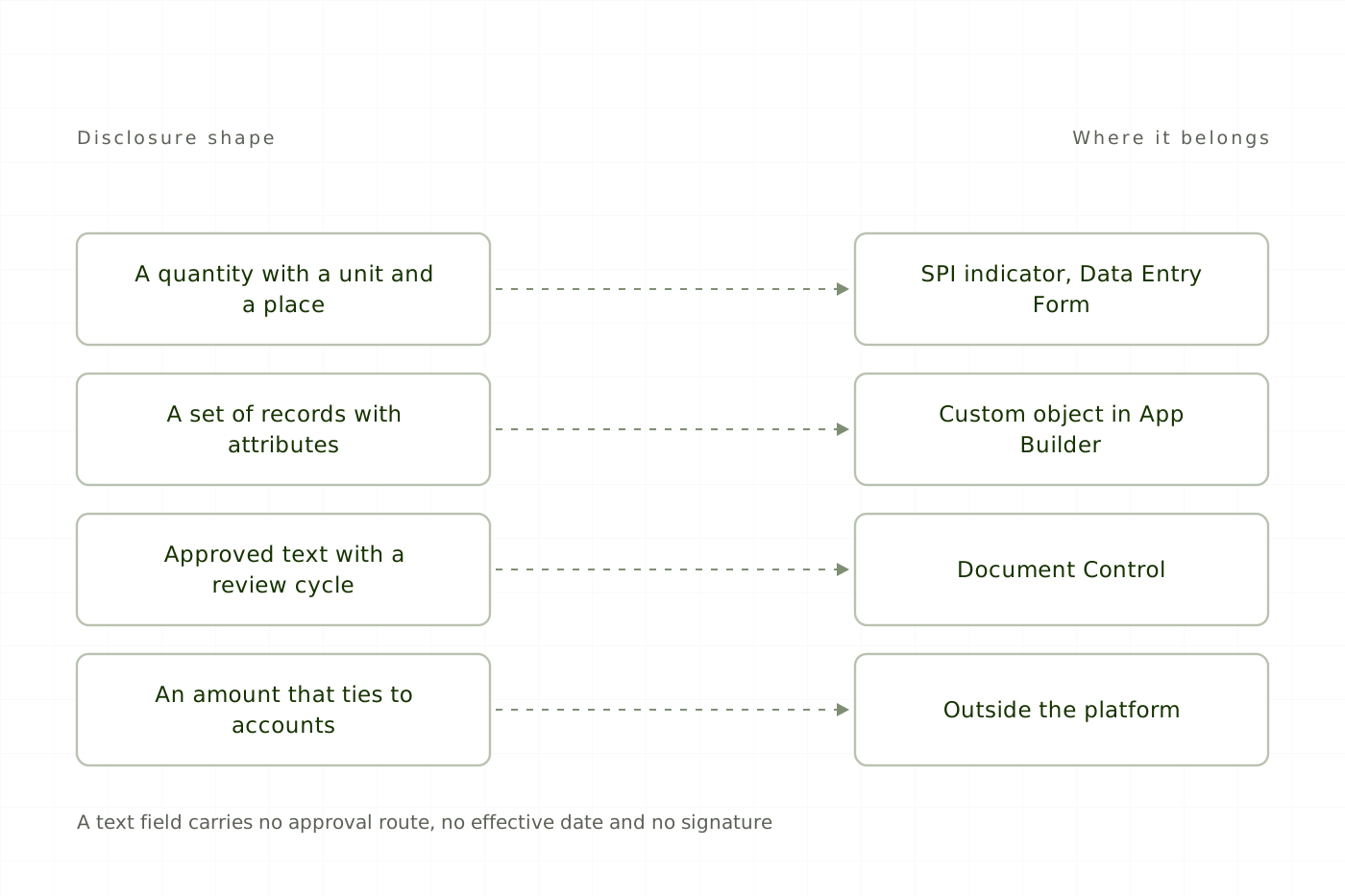
A datapoint mapping usually arrives as a spreadsheet with two columns. On the left, an ESRS reference. On the right, a blank cell waiting for an object and a field name. The first several dozen rows fill in quickly, because the first several dozen rows are quantities, and a quantity with a unit and a reporting period is what Sustainability Performance Indicators was built to hold.
Then a row asks for a description of how the administrative, management and supervisory bodies are informed about sustainability matters. There is no field for that. There is no sensible field, because the unit of that disclosure is a paragraph, and a paragraph does not aggregate, does not roll up a location hierarchy, and cannot be recalculated when a factor value changes.
This article is about the rows where the right-hand column stays blank, and what to write there instead of a field name. It works at the level of categories rather than individual datapoints, because ESRS carries well over a thousand of them and nobody can verify a full mapping inside an article. Where a specific ESRS reference appears below it is one I have checked; everywhere else the disclosure is described in words on purpose, for reasons the second-to-last section gives.
Free
Read every article, in full.
- Every article on the site, start to finish
- Sources cited and linked on all of them
- New pieces on Intelex configuration and EHS practice
Would rather not sign up? Email me and I will send it over.